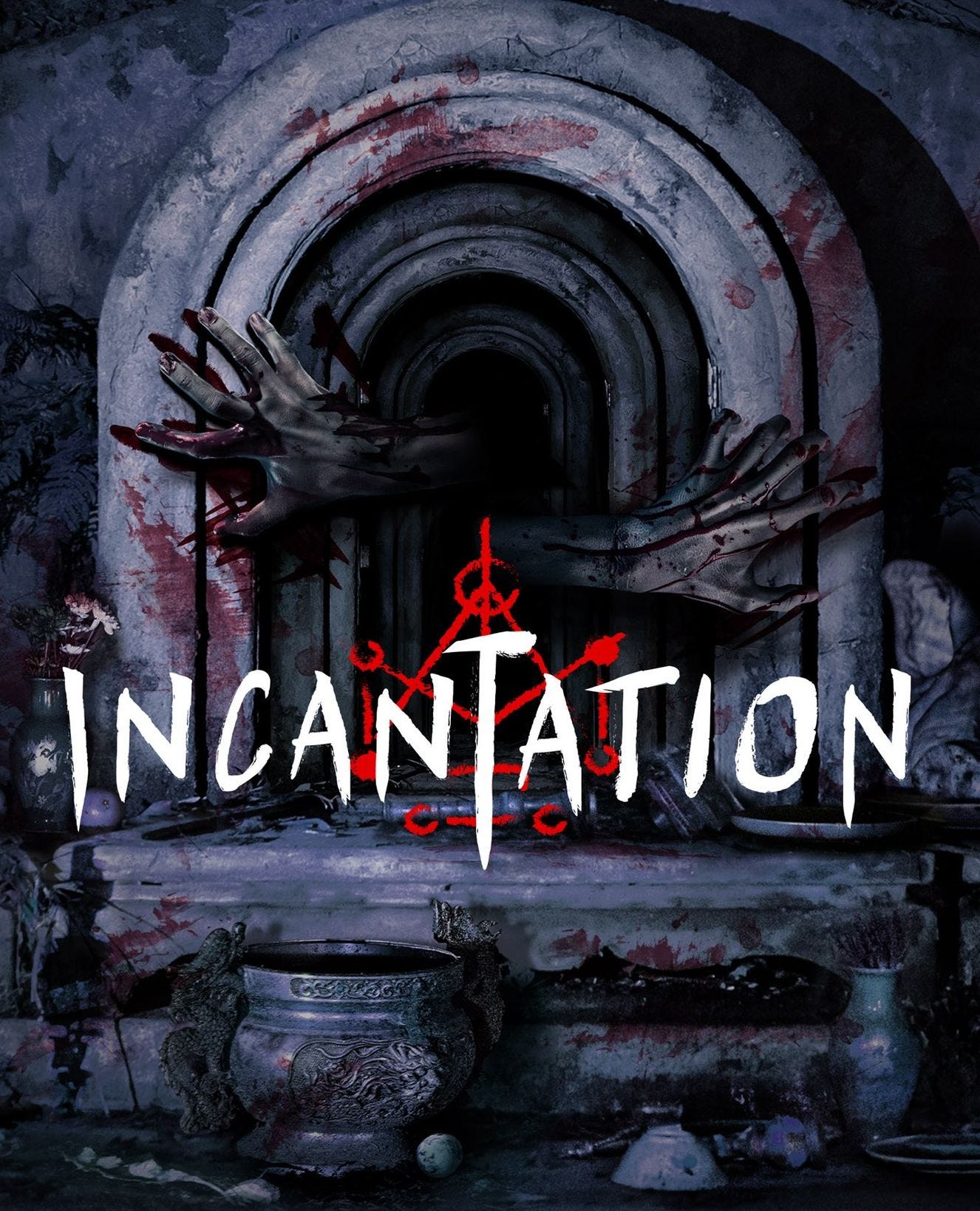
Incantation (2022)
A Taiwanese horror film about breaking a LOT of rules and finding out some consequences are carried through blood.

Welcome.
The newsletters for the month of August will be focused on horror films set in South and Southeast Asia. The first film of the month was released on Netflix and was inspired by a real (scary) incident. Incantation is something that your humble letterer enjoyed and highly recommends you view before reading this newsletter. Incantation is about a woman named Li Ronan recovering from an extremely traumatic incident that seems to affect everyone around her. Six years after the fact, the curse placed on her due to the incident reminds Ronan that it will never let her go.
Before partaking in reading this newsletter or watching the film discussed, your beloved corpse needs to give some warnings for those who might be sensitive, not particular to, or could possibly be triggered by any of the following contents: murder, suicide, religious trauma and abuse, trypophobia, gore, blood, claustrophobia, supernatural possession, self-inflicted wounds and death by them, curses, religious curses, child death, religious mutilation (children are included in this), religious cults (the definition of the word cult being used in this film and discussion: ‘a system of religious veneration and devotion directed toward a particular figure or object’), demons, and non-consensual content (this will be discussed in further detail and does not include sexual elements, but if the reader/viewer is not comfortable discussing this topic or viewing this, please take the time to skip this film and this letter).
Thank you for taking the time to consider if this is something you are comfortable viewing and reading about. Under the cut line, our discussion will begin.
If the reader is a fan of found footage films like Blair Witch Project (1999), Gonjiam: Haunted Asylum (2018), and of course any of the Ringu films and novels (also known as The Ring - often confused with The Grudge, but Ringu is Samara’s story and not Sadako), Incantation will be a delightful scream. The film is directed and co-written by Kevin Ko, a Taiwanese director who had started working in short film horror and commercials before serving the world two hard hitting long-form horror films1. Chang Che-wei was the main writer of the screenplay. Incantation focuses on a young woman named Li Ronan (played by Tsai Hsuan-yen) trying to save her daughter from a curse that is rapidly killing her. She asks you, the viewer, and your friends if they are watching the film with you, to send blessings in an attempt to stave off the curse. But a very important question after the very brief introduction of the film is: who is Ronan? Why should we care? What is this curse and if Ronan was the one who broke the rules - why is her daughter the one who got cursed?
Ronan is trying to re-adopt her six year old daughter Dodo (played with absolute talent by Huang Sin-ting) after being deemed unfit to care for her shortly after her birth. Ronan’s first impression to the audience comes off as very sincere and open with the information provided to fill in some of the gaps right away - Ronan is cursed because of breaking some very serious religious rules. Six years ago, the curse drove the decision for her to relinquish Dodo as an infant, due to an extreme (confirmed!) fear that she would die if Ronan had kept her. During the six years of rehabilitation and re-integration into the modern world, Ronan spent her time in a psychiatric facility, where her psychiatrist insists that the trauma she endured is the reason Ronan believes a curse is affecting her life and the lives around her2. What her doctor does not know is that this curse does kill the people around Ronan, though Ronan is not the one killing those people with her own hands.
A wonderful question I have seen asked in reviews (and not really speculated on or discussed past an obvious dislike of the gray area surrounding it) about Incantation are centered around one thing: if Ronan is cursed, knows that this curse kills those around her, and still avoids long-term interaction with people physically, why would she want Dodo back? In my opinion, Ronan really says it best when she herself struggles to answer that question. With that in mind, I settle firmly on two reasons that are central to the film and to Ronan’s decisions throughout: guilt and love.
But back to the film. Let’s talk about the present timeline.
Found footage as a subgenre is meant to bring the audience as close to experiencing horror as you can get. Whether it is handheld video cameras, phones, go-pros, drones, webcams, mockumentary style interviews (etc.), the purpose of documentation of the horror and the people experiencing it is key3. A wonderful example is the sigil flashed on the screen throughout the film, a reminder from Ronan that the curse put on her is serious and she needs the audience’s help to fight against it. A mantra is also needed to be spoken aloud - or in your head, either will work - so the audience can help assist Ronan in pushing back the force of this curse. Both the sigil and the mantra are consistent as an audible and visual reminder. Before we meet Dodo properly, we have to experience some moments of emotional overwhelm with Li, who chants the mantra and twists her hands into a painful-looking and odd sign of prayer. We are also introduced to another key character named Ming (Kao Ying-hsuan) who has been Dodo’s caretaker during her time in foster care. When Dodo comes home, Ronan has taken very obvious care, time, and effort into preparing her return, decorating their space with WELCOME HOME, DODO!! signs, new stuffed animals and clothes, and a bedroom set up just for Dodo. We learn Dodo’s favorite food is pineapple, she loves dogs, and that she loves her mom. Dodo asks Ronan a lot of really hard questions that Ronan in turn seems to have thought a lot about in the absence of Dodo4.
Unfortunately things do not stay happy or smooth sailing, though the moments we do get to experience are powerful and swell the heart. Dodo calls for Ronan on her first night home to get “the bad guy” out of her room - Ronan complies and finds that the invisible figure bothering her daughter is disturbingly tall. Ronan escorts the baddie out of Dodo’s bedroom and it only gets worse from here on in. At school, Dodo attacks another child for teasing her badly, drawing blood and a lot of negative attention towards Ronan and questioning her parenting. In a pretty scary scene not too long after this, something seems to possess Dodo and Ronan quickly rushes her to the hospital. While there, someone from the foster care system lets Ronan know that they are revoking her custody of Dodo and that they will be taking her back once she is well. Ronan takes Dodo secretly out of the hospital and rushes home to pack all of their things to find help from someone who will understand what is happening to her daughter. Ming, also on the scene, recognizes Ronan’s car and taps on the window to gain Dodo’s attention who was hidden under a blanket. This confirms his suspicions of Ronan running away with her.
Ming understands after talking with Dodo a little that Ronan is not an abusive and mentally unfit parent and has a moment with himself in the car. He cares very much for Dodo. Ming practically raised her and sees himself as one of her parental figures, and though he has not seen the curse or believes in it currently, he takes Dodo at her word and insists on helping Ronan get to somewhere safe while she finds a priest to help Dodo with her sudden afflictions. It’s not very common in horror to have someone like Ming - his character holds a boundless kindness and wish to understand things that are not seen but never dismisses their existence. During the next week, Ming fixes a sticker decorated handheld camera that belonged to one of Ronan’s friends. Ming updates us later, teeth falling out and nose bleeding, that he has watched the footage stored on the camera. He relays that he spotted Brahmanic text on a scroll in the recording and flew to Yunnan to ask Tantric monks for help in translating it. The mantra, translated by the monk, means: “Misfortune and blessing depend on one another, death and life lies in the name.” Ming delivers a final recorded goodbye meant for Ronan and for Dodo5, stating that because of his rapidly declining health he will not be forwarding the repaired footage…before the curse possesses him, smashing his head into the computer multiple times, forwarding the restored cursed video footage from the camera to Ronan and killing himself.
While Ronan succeeds in finding the shrine and priest who will help Dodo, she fails the week-long fast needed to properly exorcise the curse out of her daughter. No food for seven days is difficult and when faced with a sore-covered rapidly disintegrating six-year old, I do not blame Ronan for going out to buy pineapple buns and feeding her a little bit6. Realizing very quickly afterwards however that this has disrupted the process, Ronan makes another difficult decision to help Dodo throw up the pineapple, and rushes to the shrine in the middle of the night. The priest and his wife both succumb to the curse, ultimately destroying the last chance of Ronan exorcising the curse out of Dodo and her daughter ever getting better. After returning Dodo to a hospital and repeating the mantra over her, Ronan falls asleep - but Dodo starts to sleepwalk out of the hospital and into the parking lot. She stands nearby a naked body of a teenage girl, runes drawn all over her body. After Dodo and the teen are taken back into the hospital, Ronan recognizes the teen. Ronan proceeds to cut her ear off.
Are you confused? Let’s stop right before the film ends and discuss the inciting incident.
To do that we have to put this on pause and backtrack to the other timeline that is given to us in chunks throughout the film after the first act. The video camera decorated with lots of stickers - where did it come from? Is that the origin of the curse? The curse spreads…how? Lots of wonderful questions, reader, and some I have the answers to discuss.
From the beginning of the film we have a small inkling of a feeling that through Ronan’s up-front information about the curse and how it was obtained7 this is not just a found footage film. It is, in fact, a cursed found footage film, much like Samara’s VHS tape, and watching it causes Ming to kill himself. This is the first time we see that the curse is not simply latched onto Ronan in a spiritual sense, but it is able to be captured on film, copied, and mass-produced to kill others who watch it - cursing themselves with being an active voyeur in the incident leading to the curse’s escape. But we, the audience, have the privilege to watch what happens leading up to the moment before Ronan shows us the restored footage herself. By now you are turned around, dear reader, and unsure what is the cursed footage and what isn’t - to piece that divide together, we first have to talk about a few key things.
First things first.
Six years ago, Li Ronan is invited by her boyfriend Chen Dom (Sean Lin) and his brother Chen Yuan (Wen Ching-yu) to their family’s very secluded village to investigate a spooky haunted very openly stated as off limits tunnel. They have a YouTube-adjacent internet channel where they post recordings of their ghost hunts, and the Chen family spooky tunnel is next on the list! Yuan is your average ‘what’s up subscribers’ type of showman while Dom is a more reserved and quiet kind of guy. When the brothers and Ronan are stopped at the base of the Chen family’s village, the men of the village turn Ronan away at first because she isn’t a family member - to which Yuan insists that she can come inside because she is Dom’s girlfriend and his friend. There’s an argument until one of the matriarchal members of the Chen house, a very old woman, comes to give Ronan a look-over and read her palms. Begrudgingly, she is allowed through after the old woman gives the okay8.
Once inside, both the audience and Ronan are very quick to recognize that the Chen family are part of some sort of religious cult. The deity at the center is called Dahei Mother Buddha9 and all iconography of and involving her are covered by cloth, turned away, or stained with coagulated blotches of blood, forming a barrier between the deity and mortal viewing. Unbeknownst to the trio, they promise to pledge themselves - and the unborn Dodo - to Dahei Mother Buddha. Later that night, the trio sneak out to explore the tunnel and find a young girl they had spotted earlier10 standing outside of the tunnel. Ronan stays with the girl while Yuan breaks the tunnel entrance, sealed with some really heavy duty protection seal tags, and things start to immediately sour. Without the footage from Yuan’s camera, we only see the Chen family waking up and rushing up to the tunnel, tearing Ronan from the girl, and carrying out Dom’s lifeless body. Yuan brutally kills himself in front of Ronan as she flees with his camera, which renders itself unusable, and Ronan fully carries the curse of the deity due to the trespassing and breaking multiple taboos. The entire Chen family seem to have all been killed during this.
Yuan’s camera tunnel footage.
The last piece missing from the past is kindly shown to us by Ronan through the (unwillingly given) copy sent by Ming. Yuan and Dom enter the tunnel and there are a lot of obvious “oops” moments at what is revealed to dwell inside. Mirrors are placed strategically everywhere, ropes, small altars full of chunks of hair and teeth, more small idols facing away from the tunnel Blair Witch style, and of course the giant, heavy, black statue of the deity, face covered with red cloth. Dom lifts it, unleashing the curse and killing himself after his immediate possession11. Breaking the biggest taboo of trespassing and without all of the safety seals keeping that in the tunnel, you may piece together exactly what happens next.
Ronan reveals her true intentions.
Now we can finish the film.
Ronan reveals the videos are diaries for her daughter to remember her by - that she figures that Dodo is much better off without her, and without the curse she is burdened to carry because of Ronan and the Chen brothers multiple rule/taboo breaking. Ronan paints runes all over her skin and takes the audience into the tunnel - re-setting the space as it properly was - and asking for our name. The mantra is repeated, the symbol is flashed, Ronan offers the other ear of the Chen girl up as willing sacrifice, pulls a blindfold around her own eyes, and she uncovers the deity’s face. A wormhole of writhing, dark flesh and stone mold together, forcing us to stare into the pitted face of the deity as Dom had done before us.
Ronan gives us the full details: she has been lying to the audience since the beginning. The blessing mantra, giving her our name, the symbol, the hand gesture - it has all been for Dodo’s recovery but for it to possibly work, she is doing the last thing she can do, mass-cursing the audience members to dilute the curse’s afflictions on Dodo. Those who watched the film and partook - willingly or unwillingly - are now afflicted with the curse - but with enough people cursed, the less of an effect it has on Dodo. Ronan had talked with the Yunnan Tantric monks that Ming set out to gather information with, revealing now to the audience that the mantra is no blessing at all, but said to further dilute the curse, and to lighten the burden across all who agree to hold it. As Ronan was ignorant to the deity and complied in dismissing the rules set by the Chen family’s practices within the cult, information was withheld from the audience in a similar fashion. However, these things were held back from the audience by Ronan with intent behind it. She tricks the audience not only by how she presents the past and present information in multiple formats, but also with full knowledge of the consequences and process needed to have the curse work.
After the process completes itself, the curse possesses Ronan, and she kills herself by smashing her head repeatedly against the deity’s altar. At the very end of the film, we are shown footage that Dodo has healed and is doing much better - but what is going to happen to the rest of us?
Why does Ronan take Dodo back?
It’s difficult to have a solid basis of why Ronan decides to reunite with Dodo. On one hand, an answer that even Ronan struggles between, is not knowing if she did this out of love or out of guilt: after taking half a decade to recover from an extremely traumatic incident in which you assisted single-handedly wiping out all but two Chen family members12 and let loose a really awfully gnarly curse, knowing if affects everyone around you leading to a possession causing the individual’s violent death, why would you even think about returning to your child? Ronan talks about the possibility of guilt being her leading reason first - the curse that afflicts Dodo is her fault, maybe Ronan thought that since Dodo was not born during the incident she would be spared from the curse. With what we know, that would be ridiculously irresponsible to assume! Ronan knows coming back into Dodo’s life will afflict the curse because:
1.) Ronan is tied to the Mother Buddha - but Dodo was not, as she wasn’t even born yet, and her name was not offered up at a later time to the deity.
2.) Ronan is the source of the curse’s spread outward from the Chen’s village. The only reason the other surviving girl from their village wasn’t afflicted was due to the runes and her willing sacrifice of her ear. Showing up covered in those same runes to the hospital, she could have been a catalyst for Dodo - or just there to try to be the last source of any help.
3.) Ronan was very aware that the curse could and would take Dodo away from her. To punish Ronan by inflicting long bouts of suffering onto Dodo, to transfer her focus from a non-Chen to the directly connected Chen by blood, unprotected, was near-immediate.
The audience could even take Ronan’s final act as selfish and her acceptance of possession-suicide as a way of not having to face the aftermath of the curse if the film didn’t work. But we have to look at the other side of this weird cursed coin: Ronan loves Dodo, despite the possibility of Dodo not reciprocating or choosing Ming to stay with instead. Ronan grows with Dodo’s love and both of them learn from each other’s central fears - Ronan consoles Dodo through enormous action (i.e. getting rid of the “baddie”, teaching Dodo about her ‘three things’ trick, buying a puppy for Dodo knowing she’ll never see Dodo grow alongside it, the video diaries, running from social workers, creating the mass-curse) that could easily mirror guilt, yes, but Dodo’s love for her mother is genuine. Even though she is so young, Dodo understands Ronan’s reasons of giving her away to a point that she does not hold the decision against her. She is there to reinforce her mother even when she is dying next to her in a small bed, gently reassuring her not to be scared, to be strong and stay with her so she is not alone.
Even Ming is with the audience during the film, unsure about Ronan, but taking Dodo at her word, to understand her love for her mother. He watches Ronan take an extreme risk to run away with Dodo to look for spiritual help and becomes overwhelmed with recognition of love that he comes with them. Ming asks questions to understand what exactly is going on, he travels to get help for Dodo’s affliction, and restores footage hoping to gain a better understanding of what happened to ignite the rapidly spreading wildfire. Unknowingly, it is also Ming’s love of Dodo that kills him while uncovering things that Ronan might have already known or lead her to discovering just how deep the curse tunnels into a person - and why so much effort was taken by the Chen family to equate the burden of the curse and isolate themselves from everyone else to keep it that way.
The balancing act between guilt and love is where Ronan, as the shaking tightrope walker, fights with herself to stay. Doubt of full commitment to one side or the other further indicates her want for the curse to be extremely weakened by her sacrifice - knowing fully that Mother Buddha will not simply take her death as an end, and trading one life’s burdened weight for countless willing and unwilling lives to share it including Ming, the entire Chen family, the audience, and others13. Where the two facets wobble, leaving the audience by the end of the film either furious or in tears, Ronan still plummets at the end off of the wire, healing Dodo and leaving her alone…again.
So what really was the reason Ronan reunited with Dodo? We can only speculate - which your skeletal scribe does not think is a failing of the film at all, but invites further discussion of the complexity of defining humanity, respect, family found and destroyed through shared love, and the fact that sometimes curses are just really bad decisions that others can make worse for you.
Hou-ho-xiu-yi, si-sei-wu-ma…
Han
Invitation Only (2009) was his directorial debut and yanked the rug out from Taiwanese film industries - it will be covered in a future newsletter as well!
This already puts the audience in a difficult position that, throughout the film, only gets pressed tighter and tighter. Li’s doctor talks through phone calls and recorded sessions, not fully believing that Li is cursed, but not outright denying that what happened wasn’t real…to Li. The incident had created extreme PTSD, resulting in belief of a curse being the core reason for Li’s mental health plummetting. This information and character are here to remind the audience that belief can create a reality, but also to be vigilant to the possibility of an unreliable narrator.
Another common complaint/note from other reviews on the film I have read is that the found-footage style of the film is unhelpful to its audience and confusing. Your skeletal thinker disagrees! With so many differing accounts from multiple characters during differing timelines through this style, it further aids commentary on globalization, blurring of the narrative truths, and creating a pretty appropriate sense of confusion and displacement as the audience has to piece things together and gives a need to recover from each viewpoint. With an audience trying to catch up, when already believing they have the necessary information to understand what is happening currently, the sting of the reveal in the third act hurts that much more. However, I can absolutely understand why this might be negatively impacting a viewing! Calling it the reason why the film fails to meet absurdly high expectations is a critic’s fault.
Dodo is not very communicative with her mom at first, but opens up after some time and is understanding that her mom needs her as much as Dodo wants her mom to keep her this time around. She asks Ronan why she gave her away in the first place to foster care and if she even wanted her…and why she came back for her. Ronan responds: there was a monster that scared her so badly she didn’t think she could fight it, she gave Dodo away because she was scared, but she isn’t scared anymore. Dodo also gets scared very early on and we watch Ronan teach her to think of three things that make her the happiest and say them out loud to combat intense and sudden fears. Keep these things in mind.
Yes, I cried.
Yes I cried here, too.
Just the briefest of all tldrs to form a solid base to the film’s conflict source.
First rule broken: no outsiders allowed.
Dahei Mother Buddha is not an actual deity in our reality - though Buddha did have a mother, Māyā, who gave birth to him, promptly died, and returned after seven days. Almost like…the fast…hmmm… There are also cycles where Buddha is a woman, but Ko’s deity is an amalgamation of different inspiration sources. In Tantric Buddhism, the deity Dàhēitiān is one of the central inspirations - Dàhēitiān blessed the poor, a very key note of information to have recalling the film: suffering in Buddhism is inevitable and forever intertwined with living, Dàhēitiān plays parallel to blessings causing miserable side effects/misfortune. Wrathful form Kali and Mahakali are both deities within Hinduism that also bear striking resemblances to DMB - multiple arms, sacrifices of flesh/mutilations - and the importance of prepubescent girls comes from the Kumari Devi practice from Nepal. The deity Hariti is also cited as inspiration, a protector of children and women in childbirth - but only after Buddha convinced her through a great loss of her own child to stop eating little kid flesh. (Very Kronos of her.)
Second rule broken when they record a part of the ritual. Part of it includes recording this girl being painted with runes. She is important to help sew the quilt of the film together and can be easily dismissed until the parking lot. But her importance is shown through interacting with Ronan, the runes on her body, and her cutting her ear off as part of a ritual for the Chen family’s deity. The girl also directs Ronan to cut off some of her hair and feed it to a pile of frogs - in this situation I believe it is mean to symbolize a healthy birth and promote prosperity but…maybe not so much underneath the tapestry of DMB…
I felt like I was missing something after my first watch through of the film, and researched why she is covered and things are turned away from her. In Buddhist practice and belief, when there is an idol, you are supposed to face it to doorways and windows if kept inside! So why are we not allowed to look at her? The source of the curse lies in her face, but the tunnel idols were turned away from her and the entrance. Perhaps with the help of mirrors, this kept the deity from escaping by confusing its sense of direction, trapping it within the space.
Dodo and the one-eared girl.
Very closely similar to Hariti’s story - just a thought.